Southern Africa(UN: Middle Africa)
Angola
Republic of Angola
A large Atlantic country built on the memory of the Kingdom of Ndongo and Matamba, four centuries of Portuguese slaving and colonial rule, and a 27-year civil war that ended in 2002.
Scroll or pinch to zoom · drag to pan · borders: Natural Earth 1:50m
Angola in pictures
Flag, landscapes, landmarks and wildlife you can meet in the games. Photographs come from each subject’s Wikipedia article.
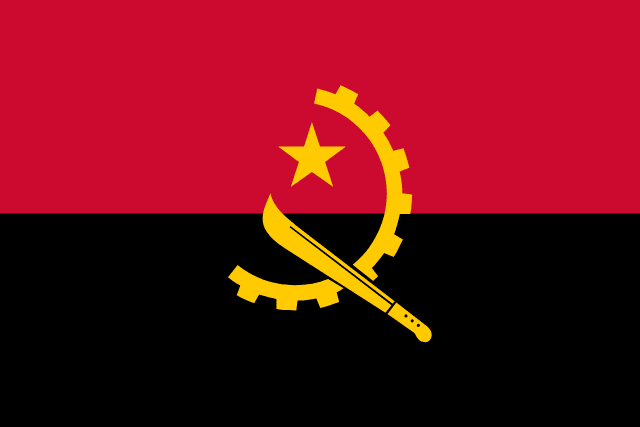
Flag
Flag of Angola
National flag
- Kalandula Falls
Landscape
Kalandula Falls
A real place in Angola
- Kalandula Falls
Landmark
Kalandula Falls
A 105-metre wall of falling water, among Africa's largest.
- Tundavala Gap
Landmark
Tundavala Gap
The plateau drops 1,000 metres in one step to the plain below.
- Kissama National Park
Landmark
Kissama National Park
Restocked by 'Operation Noah's Ark', flying elephants in from Botswana.
- Sable antelope
Wildlife
Sable antelope
A defending bull can fend off lions with its metre-long horns.
- Giant sable
Wildlife
Giant sable
Angola's national animal, feared extinct until rediscovered in 2004.
- Luanda
City
Luanda
Capital of Angola
Capital
Luanda
Population
39,040,039
World Bank, 2025
Area
1,246,700 km²
Currency
Angolan kwanza
GDP per person
$3,129
Current US$, 2025
Life expectancy
64.8 yrs
World Bank, 2024
Urban population
71.5%
UN member
Yes
Quick facts
Did you know?
The Okavango Delta in Botswana is fed by rain that falls in Angola.
Mbanza Kongo, capital of the Kingdom of Kongo, is a UNESCO World Heritage Site.
Your route
Where to start with Angola
Every chapter above begins with the essentials and then lets you keep going deeper — four levels of depth, or your own question, researched from this country's reference data and our sourced library.
Go deeper: Orientation of Angola
Researched live from this country's reference data and our library. Keep pressing to go further, or ask your own question.
Enjoying this without interruptions?
Go ad-free across the whole of MOTHERLAND from £0.99 a month. Creating a free account takes a moment.
Reference figures come from the World Bank Open Data API and the ISO 3166 country dataset, each shown with its year. Historical and cultural text is written by our editors and marks contested dating where scholars disagree. The "go deeper" chapters are generated live by Africa AI from that same reference data and our sourced library — check them before quoting. Borders shown are for orientation and do not imply a position on any dispute.