East Africa(UN: Eastern Africa)
Kenya
Republic of Kenya
An East African hub with a Swahili coast a thousand years old, a history of settler colonialism and the Mau Mau war, and today a centre of technology and athletics.
Scroll or pinch to zoom · drag to pan · borders: Natural Earth 1:50m
Kenya in pictures
Flag, landscapes, landmarks and wildlife you can meet in the games. Photographs come from each subject’s Wikipedia article.
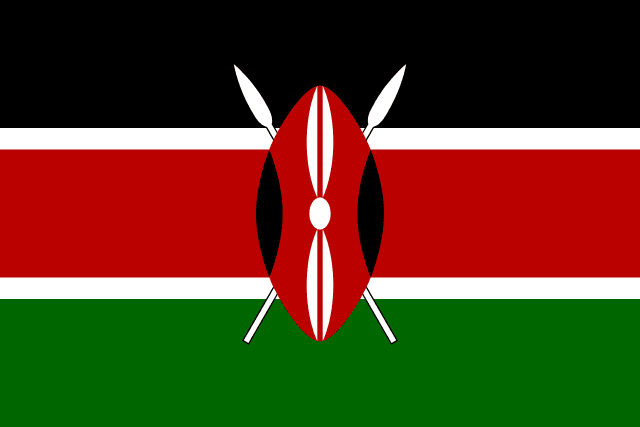
Flag
Flag of Kenya
National flag
- Maasai Mara
Landscape
Maasai Mara
A real place in Kenya
- Maasai Mara
Landmark
Maasai Mara
Two million wildebeest and zebra cross it every year in the Great Migration.
- Lamu Old Town
Landmark
Lamu Old Town
The oldest continuously lived-in Swahili town on the coast.
- Lake Nakuru
Landmark
Lake Nakuru
Flamingos gather here in flocks so dense the shore turns pink.
- Mount Kenya
Landmark
Mount Kenya
Glaciers sit almost exactly on the equator, 5,199 m up.
- Lion
Wildlife
Lion
Lions are the only big cats that live in family groups, called prides.
- African elephant
Wildlife
African elephant
The largest land animal alive — and it talks through the ground with rumbles.
- Giraffe
Wildlife
Giraffe
A giraffe's neck has exactly seven bones, the same number as yours.
- Plains zebra
Wildlife
Plains zebra
No two zebras have the same stripe pattern, like fingerprints.
- Black rhinoceros
Wildlife
Black rhinoceros
Namibia protects the last truly wild desert-adapted rhinos.
- Cheetah
Wildlife
Cheetah
Fastest land animal — from standstill to 100 km/h in three seconds.
- Lesser flamingo
Wildlife
Lesser flamingo
They turn pink from the tiny algae they filter out of the water.
- Leopard
Wildlife
Leopard
The strongest climber of the big cats — it can haul prey heavier than itself up a trunk.
- African buffalo
Wildlife
African buffalo
Herds seem to 'vote' on which way to go by the direction they stand.
- Blue wildebeest
Wildlife
Blue wildebeest
Calves can stand and run within minutes of being born.
- Warthog
Wildlife
Warthog
It reverses into its burrow so its tusks face any visitor.
- Ostrich
Wildlife
Ostrich
It can outrun a racehorse and kick hard enough to hurt a lion.
- Vervet monkey
Wildlife
Vervet monkey
It has different alarm calls for eagle, snake and leopard.
- Spotted hyena
Wildlife
Spotted hyena
Clans are led by females, and hyenas hunt far more than they scavenge.
- Olive baboon
Wildlife
Olive baboon
Troops of over a hundred travel together with the babies in the middle.
- Impala
Wildlife
Impala
It can leap ten metres forward in a single bound.
- Black-and-white colobus
Wildlife
Black-and-white colobus
It has no thumb, which helps it swing cleanly through the branches.
- Secretary bird
Wildlife
Secretary bird
It kills snakes by stamping on them with the force of five times its body weight.
- Grey crowned crane
Wildlife
Grey crowned crane
Uganda's national bird, with a golden crown of stiff feathers.
- Southern ground hornbill
Wildlife
Southern ground hornbill
It can live for sixty years and only raises one chick every nine.
- Rüppell's vulture
Wildlife
Rüppell's vulture
The highest-flying bird ever recorded — 11,000 metres up.
- Mountain bongo
Wildlife
Mountain bongo
Fewer than 100 remain in the wild, all in Kenyan highland forest.
- Grévy's zebra
Wildlife
Grévy's zebra
The biggest wild horse in the world, with round ears like a mule.
- Gerenuk
Wildlife
Gerenuk
Its name means 'giraffe-necked' in Somali.
- Kirk's dik-dik
Wildlife
Kirk's dik-dik
Pairs stay together for life and mark their patch with tears.
- Greater honeyguide
Wildlife
Greater honeyguide
It calls humans to a bees' nest, then shares the wax after the raid.
- Nile perch
Wildlife
Nile perch
It can grow to two metres and 200 kg in Lake Victoria.
- Puff adder
Wildlife
Puff adder
It hisses like a puff of steam, which is where the name comes from.
- Black mamba
Wildlife
Black mamba
Africa's fastest snake — its mouth, not its skin, is inky black.
- Serval
Wildlife
Serval
It leaps three metres straight up to catch birds in mid-air.
- Caracal
Wildlife
Caracal
Its tufted ears swivel like radar dishes to pinpoint prey.
- Honey badger
Wildlife
Honey badger
Its loose skin lets it twist around and bite an attacker holding it.
- Cape porcupine
Wildlife
Cape porcupine
Africa's largest rodent — its quills are hollow and rattle in warning.
- Bushbaby
Wildlife
Bushbaby
It can jump over two metres between branches in total darkness.
- Rock hyrax
Wildlife
Rock hyrax
It looks like a guinea pig, but its closest relative is the elephant.
- Common eland
Wildlife
Common eland
A tonne in weight and still able to clear a two-metre fence.
- Topi
Wildlife
Topi
Males stand on mounds as lookout posts to watch their patch.
- Waterbuck
Wildlife
Waterbuck
A white ring on its rump makes it easy to follow in long grass.
- Black-backed jackal
Wildlife
Black-backed jackal
Pairs mate for life and hunt, raise pups and defend a patch together.
- Nairobi
City
Nairobi
Capital of Kenya
Capital
Nairobi
Population
57,532,493
World Bank, 2025
Area
580,367 km²
Currency
Kenyan shilling
GDP per person
$2,363
Current US$, 2025
Life expectancy
63.8 yrs
World Bank, 2024
Urban population
32.2%
UN member
Yes
Quick facts
Did you know?
M-Pesa made Kenya an early world leader in mobile money.
Lamu has been continuously inhabited for over 700 years.
Your route
Where to start with Kenya
Every chapter above begins with the essentials and then lets you keep going deeper — four levels of depth, or your own question, researched from this country's reference data and our sourced library.
Go deeper: Orientation of Kenya
Researched live from this country's reference data and our library. Keep pressing to go further, or ask your own question.
Enjoying this without interruptions?
Go ad-free across the whole of MOTHERLAND from £0.99 a month. Creating a free account takes a moment.
Reference figures come from the World Bank Open Data API and the ISO 3166 country dataset, each shown with its year. Historical and cultural text is written by our editors and marks contested dating where scholars disagree. The "go deeper" chapters are generated live by Africa AI from that same reference data and our sourced library — check them before quoting. Borders shown are for orientation and do not imply a position on any dispute.