Southern Africa(UN: Southern Africa)
Namibia
Republic of Namibia
A dry, spacious country of the Namib desert and Atlantic coast, marked by the 1904–08 genocide of the Herero and Nama and by a long liberation struggle against South African rule.
Scroll or pinch to zoom · drag to pan · borders: Natural Earth 1:50m
Namibia in pictures
Flag, landscapes, landmarks and wildlife you can meet in the games. Photographs come from each subject’s Wikipedia article.

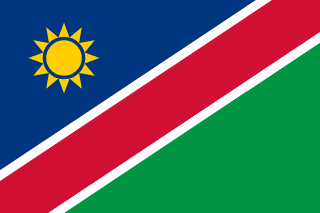
Flag
Flag of Namibia
National flag
- Sossusvlei
Landscape
Sossusvlei
A real place in Namibia
- Sossusvlei dunes
Landmark
Sossusvlei dunes
Some of the tallest sand dunes on Earth, over 300 metres high.
- Fish River Canyon
Landmark
Fish River Canyon
Africa's largest canyon, 160 km long and half a kilometre deep.
- Skeleton Coast
Landmark
Skeleton Coast
Shipwrecks rust in the sand beside seal colonies and desert lions.
- Plains zebra
Wildlife
Plains zebra
No two zebras have the same stripe pattern, like fingerprints.
- Black rhinoceros
Wildlife
Black rhinoceros
Namibia protects the last truly wild desert-adapted rhinos.
- Cheetah
Wildlife
Cheetah
Fastest land animal — from standstill to 100 km/h in three seconds.
- Lesser flamingo
Wildlife
Lesser flamingo
They turn pink from the tiny algae they filter out of the water.
- African penguin
Wildlife
African penguin
Yes — Africa has penguins, nesting on beaches near Cape Town.
- Leopard
Wildlife
Leopard
The strongest climber of the big cats — it can haul prey heavier than itself up a trunk.
- Meerkat
Wildlife
Meerkat
One meerkat always stands guard while the others dig for food.
- Ostrich
Wildlife
Ostrich
It can outrun a racehorse and kick hard enough to hurt a lion.
- Aardvark
Wildlife
Aardvark
Its name means 'earth pig' — and its burrows shelter dozens of other animals.
- Greater kudu
Wildlife
Greater kudu
Its spiral horns make two and a half full turns.
- Gemsbok oryx
Wildlife
Gemsbok oryx
It can let its body heat up to 45 °C rather than waste water sweating.
- Springbok
Wildlife
Springbok
It 'pronks' — bouncing stiff-legged two metres into the air.
- Secretary bird
Wildlife
Secretary bird
It kills snakes by stamping on them with the force of five times its body weight.
- Red lechwe
Wildlife
Red lechwe
It runs *into* deep water to escape lions, splashing at full speed.
- Kirk's dik-dik
Wildlife
Kirk's dik-dik
Pairs stay together for life and mark their patch with tears.
- Cape fur seal
Wildlife
Cape fur seal
Colonies of over 200,000 seals gather on a single stretch of sand.
- Caracal
Wildlife
Caracal
Its tufted ears swivel like radar dishes to pinpoint prey.
- Honey badger
Wildlife
Honey badger
Its loose skin lets it twist around and bite an attacker holding it.
- Rock hyrax
Wildlife
Rock hyrax
It looks like a guinea pig, but its closest relative is the elephant.
- Black-backed jackal
Wildlife
Black-backed jackal
Pairs mate for life and hunt, raise pups and defend a patch together.
- Bat-eared fox
Wildlife
Bat-eared fox
It listens for termites chewing underground, then digs them out.
- Windhoek
City
Windhoek
Capital of Namibia
Capital
Windhoek
Population
3,092,816
World Bank, 2025
Area
825,615 km²
Currency
Namibian dollar
GDP per person
$4,876
Current US$, 2025
Life expectancy
67.5 yrs
World Bank, 2024
Urban population
50.9%
UN member
Yes
Quick facts
Did you know?
Namibia was the first country to write environmental protection into its constitution.
Community conservancies manage a large share of its wildlife land.
Your route
Where to start with Namibia
Every chapter above begins with the essentials and then lets you keep going deeper — four levels of depth, or your own question, researched from this country's reference data and our sourced library.
Go deeper: Orientation of Namibia
Researched live from this country's reference data and our library. Keep pressing to go further, or ask your own question.
Enjoying this without interruptions?
Go ad-free across the whole of MOTHERLAND from £0.99 a month. Creating a free account takes a moment.
Reference figures come from the World Bank Open Data API and the ISO 3166 country dataset, each shown with its year. Historical and cultural text is written by our editors and marks contested dating where scholars disagree. The "go deeper" chapters are generated live by Africa AI from that same reference data and our sourced library — check them before quoting. Borders shown are for orientation and do not imply a position on any dispute.